International Brain Tumour Awareness Week Toolkit


Saturday, 24th October to Saturday, 31st October 2026

The 2026 International Brain Tumour Awareness Week

International Brain Tumour Awareness Week Official GraphicThe 2026 International Brain Tumour Awareness Week will be held from Saturday, 24th October to Saturday, 31st October 2026, inclusive. Please see below for some ideas. Anything, no matter how small, which you can do to raise awareness of the particular challenges of a brain tumour diagnosis and the need for a special response and an increased research effort would be greatly appreciated by the international brain tumour community.

This page offers a ‘toolkit’ of resources to help you prepare for and promote your awareness-raising activities.

Don’t forget to register/report your Awareness Week activity by completing this form.

Suggested awareness-raising activities

Below are a few suggested ideas for awareness-raising activities that you, family and friends could try:

  • Contact your local media and tell them your story
  • Share your story with local groups/schools/churches
  • Write a blog about your story / brain tumours
  • Post awareness messages on Twitter, Facebook, Tiktok, Instagram and other social media channels (see below)
  • have a Zoom tea party or quiz with friends and family to raise funds for vital brain tumour research
  • Organise a fund-raising walk, run or other activity for a brain tumour charity in your country.
  • Organise an educational webinar about brain tumours
  • Launch educational resources online

Media

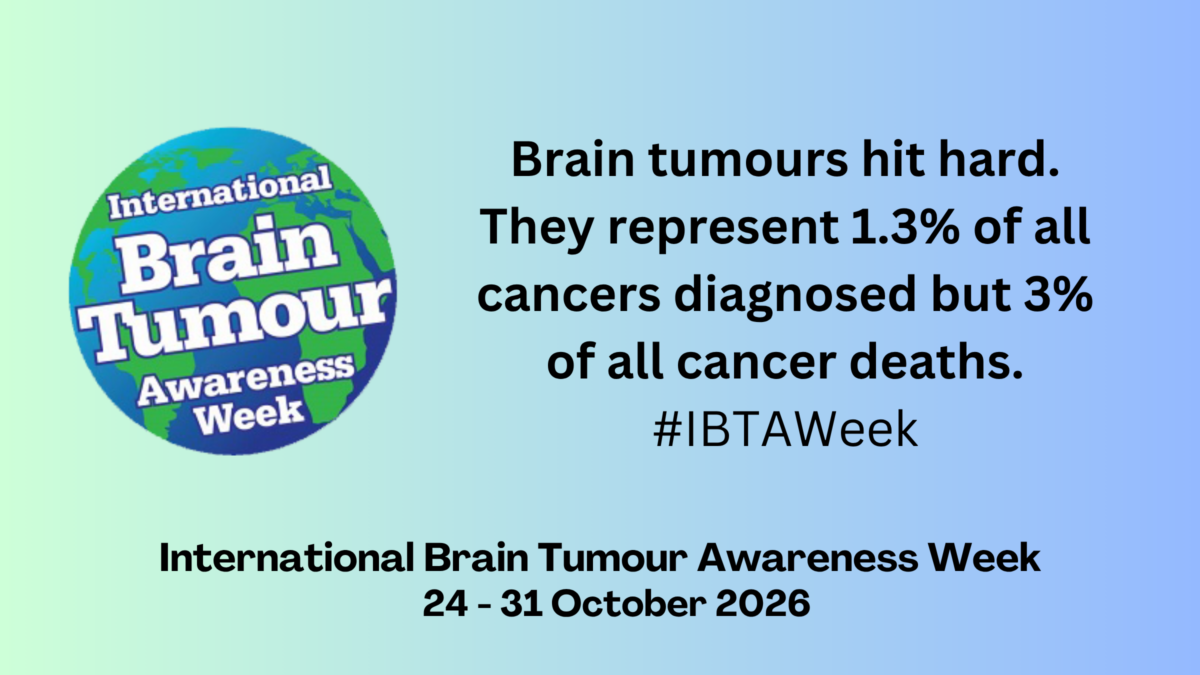
Organisations and individuals taking part in The International Brain Tumour Awareness Week can download the logos below to promote their activities (see conditions here). Click each image for a full size version. You can save the image by right-clicking and selecting ‘Save image’ in your browser.

Social media assets

Suggested images for sending with social media posts will be available soon.

Frequently Asked Questions (FAQs)

What is a brain tumour?

A brain tumour is a collection of abnormal cells in your brain. The tumour may originate in the brain (primary) or may be “metastatic” (from a cancer elsewhere in the body). A brain tumour may be non-malignant (not cancerous), however the location of the tumour can have devastating consequences.

Are brain tumours considered cancer?

Some brain tumours are cancerous, but not all of them are.  Tumours such as glioblastomas, ependymomas and oligodendrogliomas have cells that invade the brain, which defines them as cancerous, or malignant. A malignant brain tumour is a fast-growing cancer that spreads to other areas of the brain and spine. Many other tumour types such as meningiomas, craniopharyngiomas and pituitary tumours do not invade the brain which classifies them as non-malignant. Cancerous or not, many of these tumour types will cause the same types of neurological symptoms such as fatigue, short term memory loss, motor or sensory loss on one side.  And whether cancerous or not, brain tumours can be life-threatening and life-limiting.

How many people around the world are diagnosed with a brain tumour?

The rate of diagnosis varies significantly by region. The rate is lowest in Southeast Asia at 2.55 per 100,000, India at 2.85 per 100,000, and East Asia at 3.07 per 100,000. Rates are highest in Northern Europe at 6.59 per 100,000, Canada at 6.53 per 100,000, and the US at 5.74 per 100,000. Regional differences may be related to genetics or other risk factors. (Neuro Oncol 2017 Oct 19;19(11):1553-1564. doi: 10.1093/neuonc/nox091)

What are the signs and symptoms of having a brain tumour?

Symptoms may vary based on size, location and type of tumour. Symptoms may include headaches, numbness and tingling in an arm or leg, seizures, memory or cognition (thinking) problems, nausea and vomiting, changes in speech, vision or hearing. People with brain tumours may also have unexplained changes in personality. Brain tumour symptoms may start gradually (weeks to months) or rapidly, potentially leading to an urgent visit to the emergency room or primary provider/general practitioner.

How are brain tumours diagnosed?

Brain tumours are diagnosed by a doctor testing a person’s nerves and brain functions (termed a neurological examination) that would then progress to diagnostic imaging, such as a CT scan (computerized tomography) or MRI scan (magnetic resonance imaging). These tests allow healthcare providers to “see” the brain and help to identify where a tumour is and its size. Other supporting tests may include visual examination (eye test), or laboratory testing of blood and cerebrospinal fluid (the liquid that surrounds the brain and spinal cord). The patient may then be referred to a neurosurgeon who would, if appropriate, recommend a biopsy (a medical test where the neurosurgeon takes a small sample of tumour tissue for analysing in order to have more information about the tumour) or surgical removal of as much of the tumour as possible. Biopsy and surgery also mean that lab tests can be performed on the tumour to help find out about origin of the tumour (primary or metastatic, cell type, grade, molecular aspects, etc).

What is the treatment for brain tumours?

The first treatment for a brain tumour is usually surgery if it is safe and appropriate, as assessed by a neurosurgeon and their team. Sometimes only a biopsy is recommended if a tumour is in a difficult location in the brain. For malignant (cancerous) tumours surgery is rarely the only treatment. After a surgeon has obtained a pathological diagnosis of the tumour (from lab tests of the tumour tissue) and if it is determined that the tumour is malignant, the patient will then be referred to a neuro-oncologist and/or radiation-oncologist. The healthcare team will then decide – in consultation with the patient and the family – what is the best course of treatment for the patient’s tumour based on additional pathological testing. Treatment may include medications, like steroids to decrease swelling. The patient may also be advised to undergo chemotherapy (drugs that attack cancers) and radiation (of which there are a number of different types). The chemotherapy may be given alone or at the same time as the radiation therapy.

What is the difference between primary brain tumours and metastatic brain tumours?

The most common brain tumours among adults are metastatic tumours, which means they arise from cancer that formed elsewhere in the body and then spread to the brain.  These tumours most commonly spread from lung cancer, breast cancer and melanoma skin cancer. Primary brain tumours are tumours that originate in the tissues of the brain or the brain’s immediate surroundings.

What are the most common primary brain tumour types?

There are over 130 different types of primary brain tumours.  As a rule, primary brain tumours are named according to the type of brain cell that they started from. The most common primary brain tumour is a meningioma which forms in the meninges, which are the coverings of the brain.  Gliomas are the next most common group of brain tumours. These include astrocytoma, ependymoma, and oligodendroglioma. Astrocytomas are graded from 1 to 4.  Grade 1 tumours are slow growing and can often be cured with surgery. Grades 2 to 4 are considered ‘infiltrating’ and spread into the brain. The higher the grade, the more likely they are to grow and spread. The most common glioma is a glioblastoma, which is a grade 4 astrocytoma.

What is the difference between grading and staging?

‘Grade’ and ‘stage’ can have different meanings in different cancers. Staging refers to how large a cancer is and whether it has spread to in other parts of the body.  Brain tumours are not usually staged. In brain tumours, grading relates to how a brain tumour looks to the under the microscope to pathologist (the doctor who examines laboratory samples of body tissue for diagnostic or forensic purposes) as well as the results of special ‘molecular’ lab tests on the tumour. Grading is a reflection of a brain tumour’s growth potential.

What are brain tumour risk factors?

Other than rare genetic causes, the only well established risk factor for brain tumours is prior radiation exposure to the head, most often from radiation therapy to treat some other condition. Other causes include a family history of familial cancer syndrome, such as neurofibromatosis, tuberous sclerosis, von Hippel-Lindau syndrome and Li-Fraumeni syndrome.

Can primary brain tumours spread/metastasize?

Primary brain tumours may spread to other parts of the brain or spinal cord, but rarely to other parts of the body.

Are brain tumours different for adults and children?

Brain tumours in children and adults differ markedly in their rate, tumour type, and treatment. Compared with adults, paediatric tumour types (mostly ‘glial’ and ‘neuronal’ types) are more sensitive to radiation and chemotherapy. Paediatric brain tumours more often require radiation treatment to both the brain and the spine (craniospinal) since they may spread within the brain and spinal cord. The spectrum of side effects is broader for children based on age and extent of treatment: radiation therapy brings increased risk of severe long-term issues affecting neurological, endocrine (hormone), and cognitive (thinking) functions. An effort is underway to better understand adult and paediatric brain tumours biologically, with an emphasis on improving our understanding of tumour genesis (origin), how they become malignant, and some of the similarities and differences between tumour types and their response to therapies.

Are brain tumours hereditary?

About 5% of brain tumours may be linked to hereditary genetic factors or conditions, including Li-Fraumeni syndrome, neurofibromatosis, nevoid basal cell carcinoma syndrome, tuberous sclerosis, Turcot syndrome, and von Hippel-Lindau disease. Scientists have also found “clusters” of brain tumours within some families without a link to these known hereditary conditions. Studies are underway to try to find a cause for these clusters. Doctors can identify patients and families at risk for these conditions by offering genetic counseling and tests.

Are brain tumours contagious?

Brain tumours are not contagious. No one can “catch” a brain tumour from another person.

What are the chances of surviving a brain tumour?

Chances of surviving a brain tumour depend on the type and grade of brain tumour. The five-year survival rate is the percentage of people living at least five years after the tumour is found. Percentage means how many out of 100. The five-year survival rate for people with a cancerous brain or central nervous system (CNS) tumour is 36%. The ten-year survival rate is about 31%.

Survival rates decrease with age. The five-year survival rate for people younger than age 15 is more than 75%. For people aged 15 to 39, the five-year survival rate is more than 72%. The five-year survival rate for people aged 40 and over is more than 21%. However, survival rates vary widely and depend on a number of factors, including the type of brain or spinal cord tumour.

It is important to remember that statistics on the survival rates for people with a brain tumour are an estimate. The estimate comes from annual collected data based on the number of people with different types of brain tumours. Also, experts measure the survival statistics every five years. So these estimates may not show the results of better diagnosis or improved treatment available for less than five years.

Can brain tumours be cured?

Some brain tumours are found on a scan unexpectedly, they need to be observed through repeated scanning and they remain the same size. Some brain tumours require surgical removal and they do not regrow. Other brain tumours may be very aggressive and invasive. These tumours require a variety of treatments, and they may come back over time.